JOIN Fundamentals
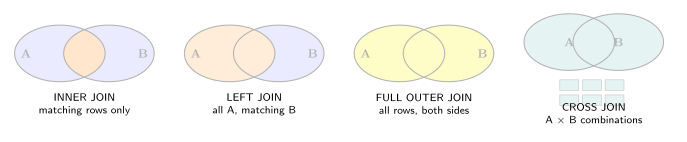
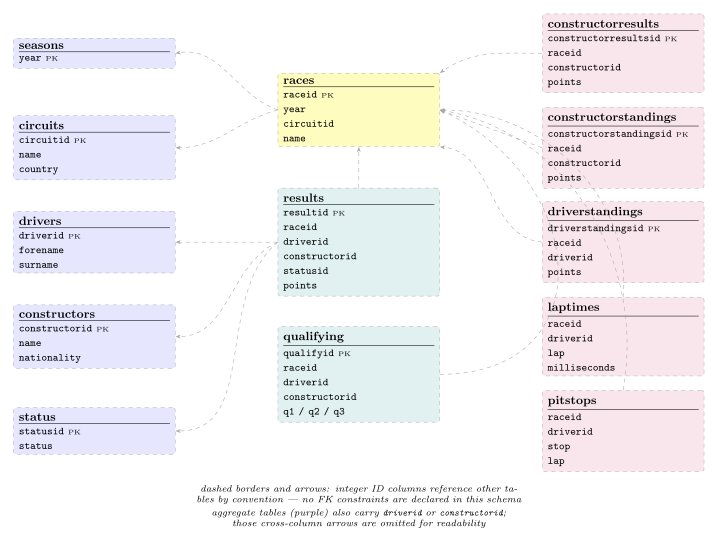
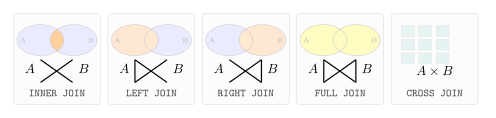
INNER, LEFT, RIGHT, FULL OUTER, CROSS, and NATURAL joins with exact output semantics. Venn diagrams describe which rows survive — CROSS JOIN is the foundation of relational algebra, not a special case.
Book reference: Chapter 19 — Understanding Relations and Joins
Free preview: What is a JOIN · NULL in SQL: Three-Valued Logic
select r.year,
       r.name         as race,
       d.surname      as driver,
       c.name         as constructor,
       res.positionorder as pos,
       res.points
  from f1db.results  res
  join f1db.races    r
    on r.raceid       = res.raceid
  join f1db.drivers  d
    on d.driverid     = res.driverid
  join f1db.constructors c
    on c.constructorid = res.constructorid
 where r.year = 2017
   and res.positionorder <= 3
 order by r.date, res.positionorder
 limit 12;
Top-three finishers per race in the 2017 season with driver and constructor names.
Multi-Table JOIN Strategies
Self-joins traverse hierarchies and compare rows within the same table. Non-equality joins match ranges. WITH RECURSIVE extends the pattern to arbitrary-depth graphs using SEARCH and CYCLE clauses.
Book reference: Chapter 19 — Understanding Relations and Joins
Free preview: What is a JOIN · WITH RECURSIVE
select r.year,
       prev.round  as prev_round,
       regexp_replace(prev.name,
         ' Grand Prix$', '') as prev_gp,
       r.round     as curr_round,
       regexp_replace(r.name,
         ' Grand Prix$', '') as curr_gp,
       r.date - prev.date   as days_gap
  from f1db.races r
  join f1db.races prev
    on prev.year  = r.year
   and prev.round = r.round - 1
 where r.year = 2017
 order by r.round;
Days between consecutive race weekends in the 2017 Formula 1 calendar.
JOIN Pitfalls
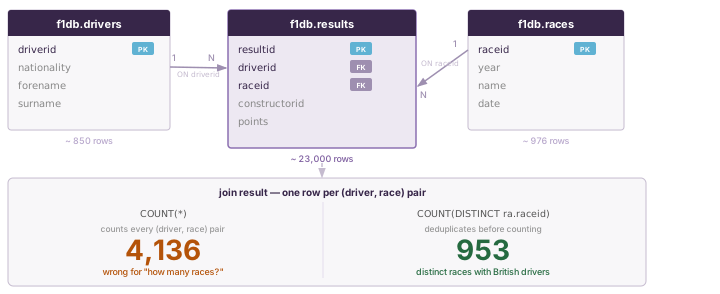
Fan-out amplification happens silently when a join key is not unique on both sides. EXISTS and NOT EXISTS avoid double-counting; the NOT IN null trap is one of SQL's most common bugs.
Book reference: Chapter 19 — Understanding Relations and Joins
Free preview: JOIN Amplification & Cardinality
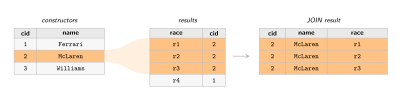
-- Amplified (wrong): counts result rows,
-- not distinct constructors, because the
-- 1:N join multiplies each constructor
-- by all its result rows.
select c.name          as constructor,
       count(*)        as result_rows
  from f1db.constructors c
  join f1db.results res
    on res.constructorid = c.constructorid
 group by c.constructorid, c.name
 order by result_rows desc
 limit 5;
Race result rows per constructor ranked by total entries across all seasons.
LATERAL JOINs
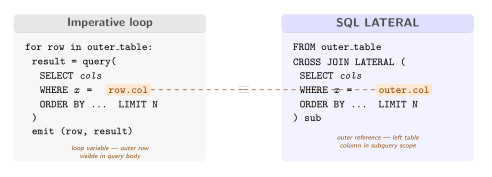
LATERAL allows the right-hand subquery to reference columns from the left row. This enables top-N per group, kNN geographic search, and row-by-row correlated computation that a plain JOIN cannot express.
Book reference: Chapter 19 — Understanding Relations and Joins
Free preview: LATERAL: Top-N Per Group
select d.surname       as driver,
       top3.race,
       top3.pos,
       top3.points
  from f1db.drivers d
  join lateral (
    select r.name  as race,
           res.positionorder as pos,
           res.points
      from f1db.results res
      join f1db.races   r
        on r.raceid = res.raceid
     where res.driverid = d.driverid
       and r.year       = 2017
       and res.points   > 0
     order by res.points desc
     limit 3
  ) top3 on true
 where d.surname in (
   'Hamilton','Vettel','Bottas'
 )
 order by d.surname, top3.points desc;
Top three highest-scoring race results in 2017 for Hamilton, Vettel, and Bottas.
Aggregation and Window Functions with JOINs
Combining GROUP BY and window functions with JOINs requires careful ordering. FILTER and CASE inside aggregates often eliminate the need for a second join pass.
Book reference: Chapter 19 — Understanding Relations and Joins
Free preview: JOIN Amplification & Cardinality
select d.surname              as driver,
       r.round,
       left(r.name, 14)       as race,
       res.points,
       sum(res.points) over (
         partition by d.driverid
         order by r.date
         rows between unbounded preceding
                  and current row
       )                      as cum_pts
  from f1db.results res
  join f1db.drivers d
    on d.driverid = res.driverid
  join f1db.races   r
    on r.raceid   = res.raceid
 where r.year = 2017
   and d.surname in ('Hamilton', 'Vettel')
 order by d.surname, r.date;
Cumulative championship points per race for Hamilton and Vettel across the 2017 season.
Complex Query Composition
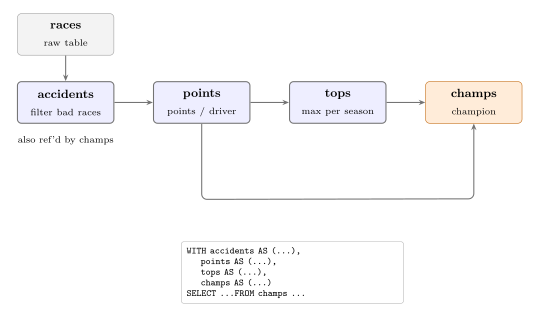
WITH (CTEs), nested subqueries, and LATERAL chain together into readable multi-step computations. The MATERIALIZED option controls whether PostgreSQL treats a CTE as a fence or inlines it as a subquery.
Book reference: Chapter 19 — Understanding Relations and Joins
Free preview: What is a JOIN · NULL in SQL: Three-Valued Logic
select forename, surname,
       constructors.name    as constructor,
       count(*)             as races,
       count(distinct status) as reasons
  from f1db.drivers
       join f1db.results      using(driverid)
       join f1db.races        using(raceid)
       join f1db.status       using(statusid)
       join f1db.constructors using(constructorid)
 where date >= date '1978-01-01'
   and date <  date '1978-01-01'
                + interval '1 year'
   and not exists (
     select 1
       from f1db.results r
      where position is not null
        and r.driverid = drivers.driverid
   )
 group by constructors.name, driverid
 order by count(*) desc limit 10;
Drivers who entered at least one 1978 race without ever finishing.
JOIN Performance
Hash Join, Nested Loop, and Merge Join — how the planner chooses and what to do when the estimate is wrong. Index-nested-loop for selective predicates, parallel hash for large equi-joins.
Book reference: Chapter 19 — Understanding Relations and Joins
Free preview: JOIN Amplification & Cardinality
explain (analyze, buffers)
select d.nationality,
       count(distinct d.driverid)  as drivers,
       sum(res.points)             as total_points
  from f1db.results res
  join f1db.drivers d
    on d.driverid = res.driverid
 group by d.nationality
 order by total_points desc;
Execution plan for total points and driver count aggregated by nationality.
Architecture: Designing Join-Heavy Systems
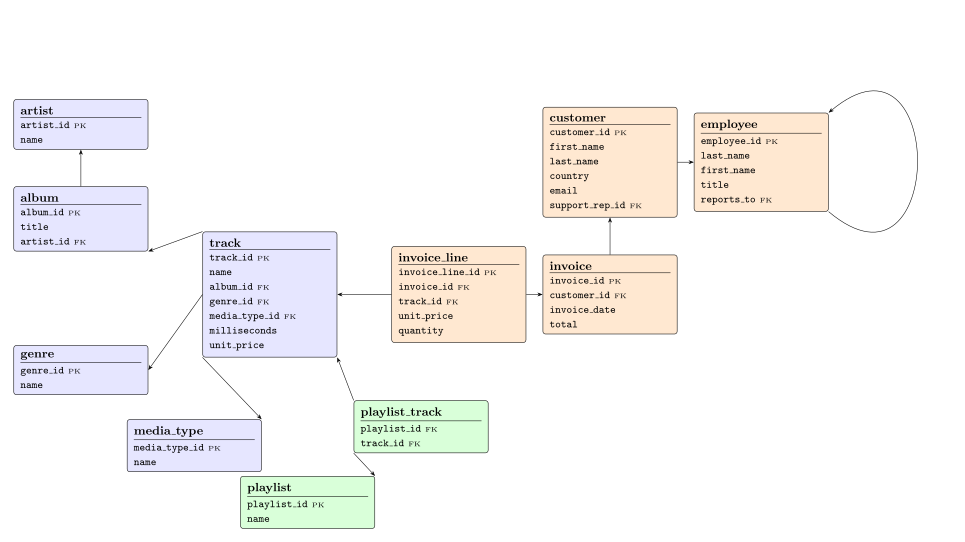
Normalization vs pre-joined denormalized tables for read-heavy workloads. Foreign data wrappers for cross-schema JOINs, join planning for partitioned tables, and when to move joins out of the database.
Book reference: Chapter 19 — Understanding Relations and Joins
-- Normalized: re-computed on every request
select c.name                           as constructor,
       count(distinct res.driverid)     as drivers,
       count(distinct res.raceid)       as races,
       count(*) filter(
         where res.positionorder = 1)   as wins,
       sum(res.points)                  as total_points
  from f1db.constructors c
  join f1db.results res
    on res.constructorid = c.constructorid
 group by c.constructorid, c.name
 order by total_points desc
 limit 10;
Constructor career totals: distinct drivers, races entered, wins, and cumulative points.