Foundations of Aggregation
GROUP BY collapses rows into groups and the evaluation order — WHERE → GROUP BY → HAVING → SELECT — determines which clauses can reference aggregate results. This module builds that mental model against F1 race data.
Book reference: Chapter 16 — Group By, Having, With, Union All
Free preview: GROUP BY and HAVING · Common Aggregate Functions

select extract(
         'year' from
         date_trunc('decade', date)
       ) as decade,
       count(*) as races
  from races
 group by decade
 order by decade;
Race count grouped by decade across all of F1 history.
Correctness in Aggregates
COUNT(col) excludes NULLs while COUNT(*) does not. COUNT DISTINCT carries hidden performance costs. This module traces every correctness trap with working examples on real datasets.
Book reference: Chapter 16 — Group By, Having, With, Union All
Free preview: GROUP BY and HAVING · Common Aggregate Functions · The FILTER Clause
select extract(year from races.date)
         as season,
       count(distinct raceid) as nb_races,
       count(*) as nb_status,
       count(*) filter(
         where status = 'Accident'
       ) as accidents,
       round(100.0
         * count(*) filter(
             where status = 'Accident'
           )
         / count(*), 2) as pct
  from results
       join status using(statusid)
       join races  using(raceid)
 group by season
 order by accidents desc
 limit 5;
Top 5 seasons by accident count, with total results and accident percentage per season.
Multi-Level Aggregation Patterns
Window functions combined with GROUP BY enable multi-level summaries without running the query twice. Nested subqueries let you aggregate over aggregates cleanly.
Book reference: Chapter 16 — Group By, Having, With, Union All
Free preview: Common Aggregate Functions
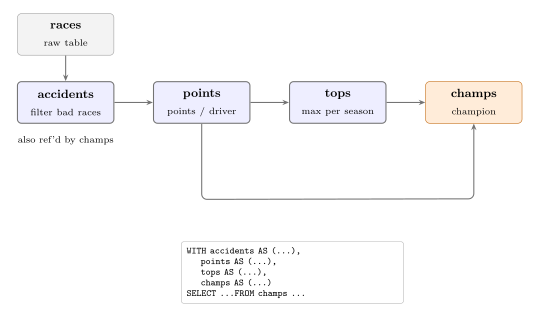
with decade_points as (
  select extract('year' from
           date_trunc('decade', races.date)
         )::int as decade,
         drivers.driverid,
         drivers.surname,
         sum(results.points) as points
    from results
         join races   using(raceid)
         join drivers using(driverid)
   group by decade,
            drivers.driverid,
            drivers.surname
),
decade_max as (
  select decade, max(points) as top
    from decade_points
   group by decade
)
select dp.decade,
       dp.surname as top_scorer,
       dp.points
  from decade_points dp
       join decade_max dm using(decade)
 where dp.points = dm.top
 order by dp.decade;
The highest-scoring F1 driver in each decade, with their total points for that decade.
Advanced GROUP BY Features
GROUPING SETS computes multiple GROUP BY combinations in one scan. ROLLUP adds hierarchical subtotals; CUBE adds all cross-tabulations. GROUPING() distinguishes a NULL result from a missing row.
Book reference: Chapter 16 — Group By, Having, With, Union All
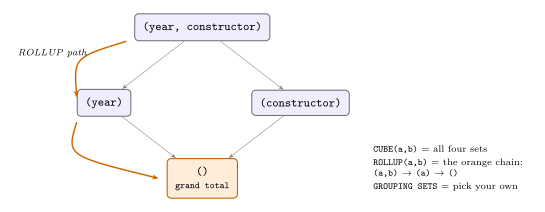
select drivers.surname     as driver,
       constructors.name   as constructor,
       sum(points)         as points
  from results
       join races        using(raceid)
       join drivers      using(driverid)
       join constructors using(constructorid)
 where drivers.surname in ('Prost', 'Senna')
 group by rollup(
   drivers.surname,
   constructors.name
 );
Points for Prost and Senna by constructor, with per-driver subtotals and a grand total.
Combining Aggregates with Other SQL Features
The FILTER clause computes conditional counts and sums in a single pass — far faster than multiple CASE expressions. Ordered-set aggregates (percentile_cont, mode) extend what GROUP BY can express.
Book reference: Chapter 16 — Group By, Having, With, Union All
Free preview: Common Aggregate Functions · The FILTER Clause
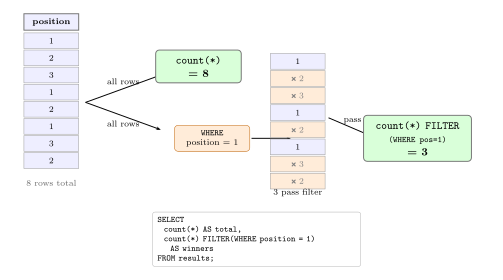
with season_results as (
  select constructors.constructorid,
         constructors.name as constructor,
         results.points,
         results.position,
         results.milliseconds,
         results.raceid
    from results
         join races        using(raceid)
         join constructors using(constructorid)
   where races.year = 2017
)
select constructor,
       count(*) as entries,
       count(*) filter(
         where position = 1) as wins,
       count(*) filter(
         where milliseconds is null
           and position    is null) as dnfs,
       sum(points) as total_points
  from season_results
 group by constructorid, constructor
having count(*) >= 20
 order by total_points desc;
2017 F1 constructor standings with race entries, wins, DNFs, and total points for teams with 20+ entries.
Performance & Scalability of Aggregations
HashAgg vs SortedAgg, spill to disk, and partial aggregation in parallel plans. This module explains when to pre-aggregate into a materialized view versus aggregating live at query time.
Book reference: Chapter 16 — Group By, Having, With, Union All
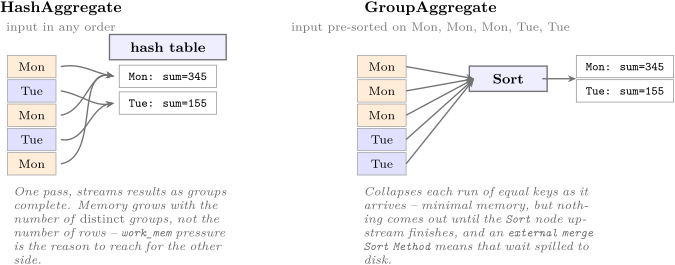
explain
  select extract(
           'year' from
           date_trunc('decade', date)
         ) as decade,
         count(*) as races
    from races
   group by decade;
EXPLAIN output for a decade-level race count grouped by a computed decade expression.
Designing Reliable Reporting Queries
Reliable reporting queries stay correct as data grows — no implicit column dependencies, no unstable GROUP BY expressions, behavior verified with realistic data volumes before going to production.
Book reference: Chapter 16 — Group By, Having, With, Union All
Free preview: Percentiles & Ordered-Set Aggregates
with seasons as (
  select generate_series(2007, 2017)
         as season
),
mclaren_wins as (
  select races.year as season,
         count(*)   as wins
    from results
         join races        using(raceid)
         join constructors using(constructorid)
   where constructors.name = 'McLaren'
     and races.year between 2007 and 2017
     and position = 1
   group by races.year
)
select s.season,
       coalesce(w.wins, 0) as wins
  from seasons       s
       left join mclaren_wins w
         using(season)
 order by s.season;
McLaren's win count for each year from 2007 to 2017, including seasons with zero wins.
Aggregation in Data Architectures
MERGE, upsert patterns, and incremental aggregation maintain summary tables at scale. Trade-offs between query-time aggregation, periodic rollups, and streaming pre-aggregation.
Book reference: Chapter 16 — Group By, Having, With, Union All
insert into constructor_season_summary
       (season, constructorid, name,
        points, races)
  select races.year,
         constructors.constructorid,
         constructors.name,
         sum(results.points),
         count(distinct results.raceid)
    from results
         join races        using(raceid)
         join constructors using(constructorid)
   where races.year between 2010 and 2017
   group by races.year,
            constructors.constructorid,
            constructors.name
on conflict (season, constructorid)
   do update set
     points = excluded.points,
     races  = excluded.races;
Constructor season totals upserted into a summary table, safe to re-run for 2010–2017.