Systematic bottleneck identification, query rewriting, index strategy, and verified improvements.
8Modules
4Core
3Advanced
1Architect
Module 01
Finding What to Optimize
Core · 4 topics
"The database feels slow" is not a starting point — it's a symptom without a location. Before anything is EXPLAINed, the first job is triaging pg_stat_statements into a ranked, reproducible list of what to fix first.
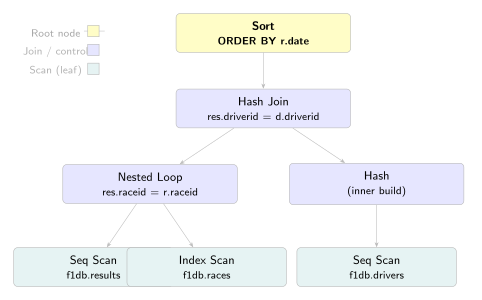
Trace the path a query takes from parsing to execution.
Module 01 · pg_stat_statements triage
select query,
       calls,
       round(total_exec_time::numeric, 1) as total_ms,
       round(mean_exec_time::numeric, 1)  as mean_ms,
       round((100 * total_exec_time
              / sum(total_exec_time) over ())::numeric, 1)
                                           as pct_total
  from pg_stat_statements
 order by total_exec_time desc
 limit 10;
Top 10 statement shapes ranked by cumulative execution time and share of total load.
Module 02
Indexing for Performance
Core · 7 topics
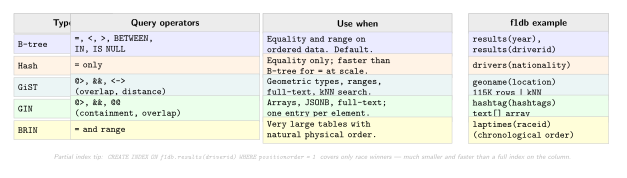
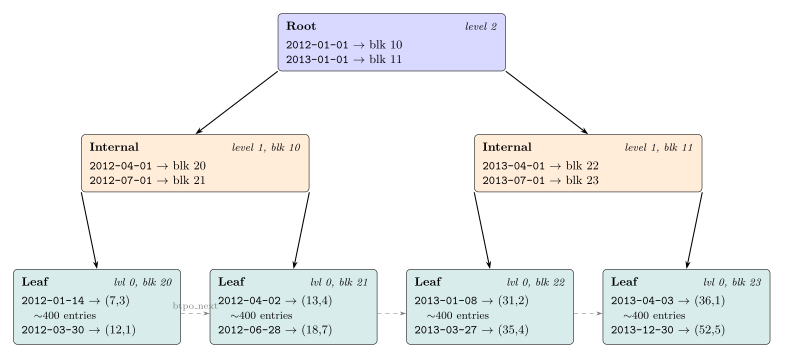
An index gives the planner a new access path: instead of scanning every page, it can follow the B-tree straight to matching rows. This module covers every index type f1db, geoname, and hashtag put to use.
Match the index variant to the query it needs to serve.
Module 02 · Partial index targeting
-- This query scans all results to find
-- race winners — a partial index on
-- positionorder = 1 would eliminate it.
--
-- CREATE INDEX ON f1db.results (raceid)
-- WHERE positionorder = 1;
explain (analyze, buffers)
select res.raceid,
       res.driverid,
       res.constructorid
  from f1db.results res
 where res.positionorder = 1
 order by res.raceid;
Raceid, driverid, and constructorid for every race winner, ordered by raceid.
Module 03
Query Rewriting Techniques
Core · 5 topics
Small changes in SQL can have large performance impacts. The most effective rewrites work with the planner's cost model — reducing intermediate result sets and removing barriers it can't see through.
-- Inline predicates give the planner freedom
-- to push them to the earliest scan.
explain (analyze, buffers)
select r.name, r.date,
       d.surname as winner
  from f1db.races   r
  join f1db.results res
    on res.raceid        = r.raceid
   and res.positionorder = 1
  join f1db.drivers d
    on d.driverid        = res.driverid
 where r.year = 2017;
Race names, dates, and 2017 winners with all predicates placed inline in the join.
Module 04
Common Anti-Patterns
Core · 3 topics
Some slow queries are not exotic at all — they are the same handful of mistakes, written daily in every codebase. Each one has a recognizable EXPLAIN signature and a mechanical fix.
-- Keyset: seek straight to the last key seen.
-- The B-tree descends once and reads exactly
-- one page of rows — page 5000 costs the
-- same as page 1.
explain (analyze, buffers)
select geonameid, name
  from geoname.geoname
 where geonameid > 10150618
 order by geonameid
 limit 20;
Twenty geoname rows starting after a known geonameid boundary, ordered by geonameid.
Module 05 · Advanced
Statistics: Correlated Columns
Advanced · 4 topics
Every planner estimate assumes columns are independent unless told otherwise — selectivity(a=1 AND b=2) is computed as if knowing one told you nothing about the other. CREATE STATISTICS fixes that.
Misestimation from correlated columnsFix row-count misestimates caused by columns that are not statistically independent.
02
ndistinct: multi-column GROUP BY cardinality; mcv: correlated but not functionally dependentChoose the right extended-statistics kind for the misestimate you're seeing.
03
Expression statistics; confirming the fix in pg_stats_extVerify a CREATE STATISTICS fix actually changed the planner's estimate.
04
SET STATISTICS: one column's sample; choosing the right toolPick between per-column sample size and extended statistics for a given problem.
Spot estimate divergence and trace it to a correlated-column problem.
Module 05 · Correlated column misestimate
-- geoname.class and .feature are strongly
-- correlated: 'PPL' always implies class 'P'.
-- The planner multiplies selectivities as
-- if they were independent and lands far
-- below the actual row count.
--
-- create statistics geoname_class_feature
--   (dependencies) on class, feature
--   from geoname.geoname;
explain (analyze, buffers)
select name, population
  from geoname.geoname
 where class   = 'P'
   and feature = 'PPL';
EXPLAIN ANALYZE plan for geoname rows matching both class 'P' and feature 'PPL'.
Module 06 · Advanced
Configuration Tuning
Advanced · 5 topics
Indexes, rewrites, and statistics change what the planner knows and what access paths exist. Configuration changes what the planner believes about the hardware itself — memory, cost, and parallelism settings.
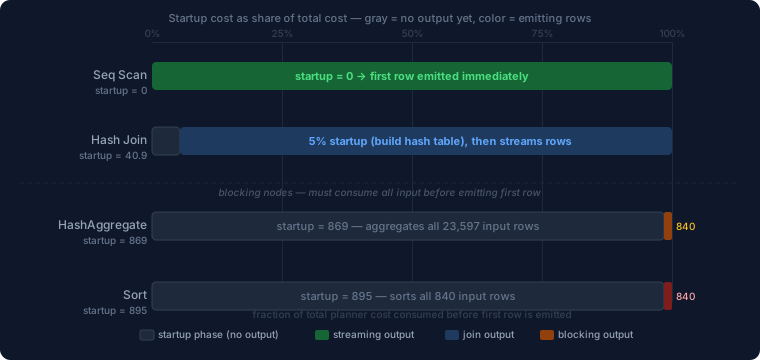
See how memory, cost, and parallelism settings interact.
Module 06 · Cost and memory settings
select name,
       setting,
       unit,
       short_desc
  from pg_settings
 where name in (
   'work_mem',
   'effective_cache_size',
   'random_page_cost',
   'seq_page_cost',
   'max_parallel_workers_per_gather'
 )
 order by name;
Name, setting, unit, and description for five memory, cost, and parallelism parameters.
Module 07 · Advanced
Systematic Optimization Workflow
Advanced · 5 topics
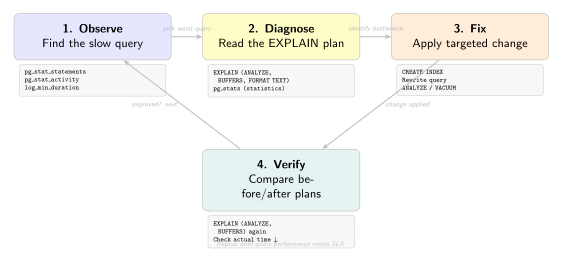
By this point you have a diagnosis and a full toolbox — indexes, rewrites, extended statistics, configuration. This module is the discipline that turns fixes into verified, monitored improvements.
Follow each step of a repeatable optimization cycle.
Module 07 · Baseline plan comparison
-- Step 1: capture the default plan and cost.
-- Step 2: apply one fix, then compare actual
-- time against the captured baseline.
explain (analyze, buffers)
select d.surname,
       sum(res.points) as points
  from f1db.results res
  join f1db.drivers d
    on d.driverid = res.driverid
 group by d.driverid, d.surname
 order by points desc
 limit 10;
Total career points per driver ranked descending, limited to the top 10.
Module 08 · Architect
Performance Architecture
Architect · 6 topics
At scale, query optimization becomes part of system design. Partitioning strategy, parallelism, materialized views, and denormalization determine whether individual query fixes hold up under load.
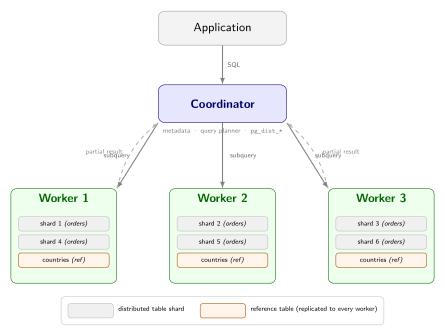
Scale out with Citus: coordinator, workers, and sharded data.
Module 08 · Partition inventory
select parent.relname  as parent_table,
       child.relname   as partition_name,
       pg_size_pretty(
         pg_relation_size(child.oid)
       )               as partition_size
  from pg_inherits
  join pg_class parent
    on parent.oid = pg_inherits.inhparent
  join pg_class child
    on child.oid  = pg_inherits.inhrelid
  join pg_namespace n
    on n.oid      = parent.relnamespace
 where n.nspname = 'f1db'
 order by parent.relname, child.relname;
Every f1db partition's name and physical size, grouped by parent table.
All 6 courses. One package.
Core, Advanced, and Architect tiers — 48 modules across 6 PostgreSQL courses.