AI tools can generate a query from a plain-English description. What they
cannot do is understand your database, design your schema, or catch a
wrong JOIN that runs without error but returns subtly incorrect
numbers. That is still a human job — and it starts with knowing SQL.
AI writes queries. You still decide what to ask.
The question is no longer "can I write this query?" — it is "do I know what query to write?"
The most powerful use of an AI coding assistant is not typing write me a SQL query. It is knowing exactly what the query should do — which join type, which aggregation, whether a window function or a subquery fits the logic — and using the assistant to get there faster.
That knowledge is what separates a developer who gives the AI a precise prompt and reviews the result confidently from one who pastes the output into production and hopes. The first person knows SQL. The second is guessing.
Your database is not in the training data.
Production schemas have undocumented tables, cryptic column names, and implicit business rules.
Text-to-SQL tools perform well on clean, well-documented schemas with
roughly twenty tables and explicit foreign keys. On the
BIRD benchmark
— which was designed specifically for real-world database conditions —
accuracy drops to around 64% on complex queries, even
with ideal, well-documented inputs. Real production databases are
different: columns named flg_acct_tp, tables that were
deprecated three years ago but are still joined in a dozen queries,
foreign key relationships that were never declared.
The AI does not know your schema is broken. It does not know that
orders.status = 3 means "shipped" in your system. You do —
or you should — and that understanding comes from knowing what a
relational model is supposed to look like and recognizing when yours
diverges from it.
"People doing mission-critical, secure, accurate database development on large existing databases will still struggle in 2026 due to undocumented databases and bad tooling."
— Brent Ozar, January 2026Wrong SQL runs. You need to catch it.
A bad LEFT JOIN returns numbers. They just aren't the right ones.
SQL errors fall into two categories: syntax errors, which the database rejects immediately, and logic errors, which the database happily executes and returns plausible-looking numbers that are quietly wrong.
Using a LEFT JOIN where an INNER JOIN is
correct inflates aggregates with NULL-padded rows.
Grouping at the wrong level double-counts. Filtering after a join
instead of before changes the result set. None of these produce an
error. They produce a wrong answer that looks right until someone
compares it against another source.
AI-generated SQL is only useful if you can read it, evaluate it, and catch what is wrong. That skill is exactly what SQL literacy gives you — and it matters more in the AI era, not less.
We cover both mistakes in detail, with actual SQL run against a real database: a LEFT JOIN that silently drops 198 rows when paired with a WHERE on the right-side table, and a COUNT(*) that overcounts by a factor of four because the join multiplies rows.
Schema design is not a query problem.
The most consequential SQL decisions happen before a single SELECT is written.
How you model a many-to-many relationship, whether a timeline should use
a tstzrange or two timestamp columns, when a generated
stored column is the right answer versus a view — these are design
decisions that determine which queries are fast, which constraints
enforce correctness at write time, and which ones require a trigger or
an application workaround to work around a brittle schema.
An AI cannot make these choices for you because the choices depend on
your specific access patterns, your team's operational practices, and
your tolerance for schema migration complexity. The only way to make
them well is to understand what PostgreSQL can actually express — range
types, exclusion constraints, partial indexes, generated columns,
MERGE, row-level security — so you know what options exist
before you commit to a design.
That is the argument at the center of this book: knowing what is possible lets you make better design decisions than any tool that only looks at the query surface.
We work through a concrete example with actual SQL:
the schema decision AI cannot make
— how knowing PostgreSQL has int4range and exclusion constraints changes
what you ask for, and what you get back.
The market has not moved on from SQL.
Demand for SQL expertise is higher in 2026 than it was in 2019 when the first edition was published.
SQL appears in 65–75% of data-related job descriptions — more than Python, R, or any specific machine learning framework. The language is standardized, stable, and supported by every relational database. AI tools generate it, which means every data-adjacent role now assumes you can read it and verify it, even if you no longer type every character by hand.
PostgreSQL in particular has never been more relevant. Seven major
versions since 2019 have added window frame modes, multi-ranges,
MERGE, RETURNING OLD / NEW, JSON_TABLE,
virtual generated columns, and uuidv7() — none of which an AI
will reach for if it does not know you need them.
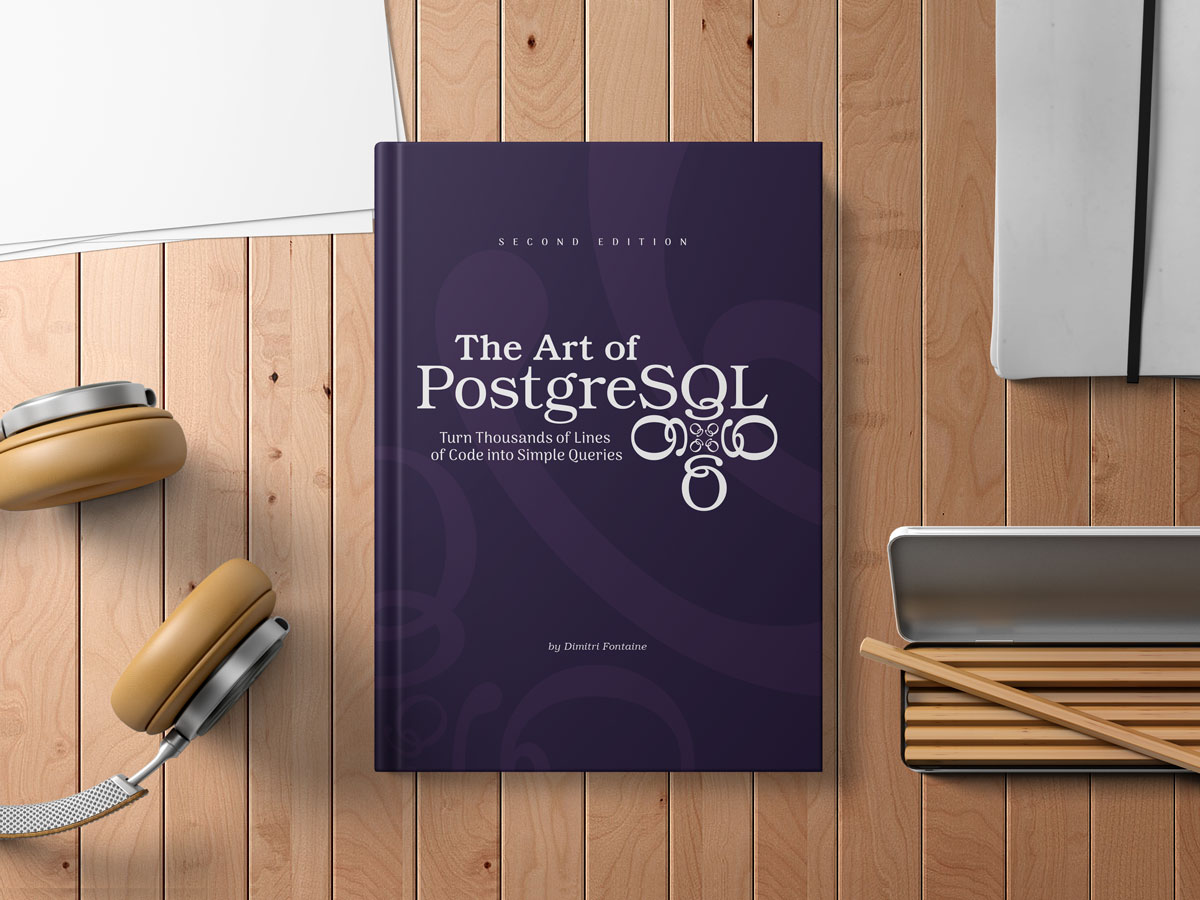
The Art of PostgreSQL, Second Edition
A book for developers who want to understand SQL deeply enough to design better schemas, write correct queries, and know what to ask — with or without an AI in the loop.