The FILTER Clause: Multiple Counts in One Pass
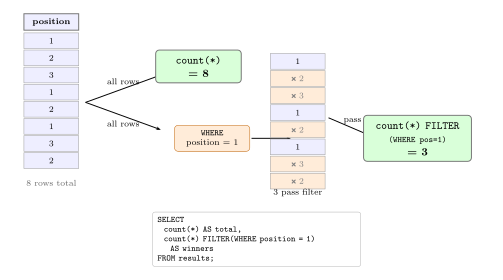
count(*) FILTER (WHERE condition) computes conditional aggregates without CASE expressions or separate subqueries — one scan, multiple results.
Suppose you want a summary that shows, for each Formula One season, the total number of race entries and the number that ended in an accident. The naive approach is two separate queries or a subquery for each number. There is a better way.
PostgreSQL supports a FILTER clause on individual aggregate functions:
  select extract(year from races.date) as season,
         count(distinct raceid)                            as nb_races,
         count(*)                                          as nb_status,
         count(*) filter(where status = 'Accident')       as accidents,
         round(100.0
               * count(*) filter(where status = 'Accident')
               / count(*), 2)                             as pct_accidents
    from results
         join status using(statusid)
         join races  using(raceid)
group by season
order by accidents desc
   limit 5;
 season │ nb_races │ nb_status │ accidents │ pct_accidents
════════╪══════════╪═══════════╪═══════════╪═══════════════
   1977 │       17 │       477 │        60 │         12.58
   1975 │       14 │       363 │        54 │         14.88
   1978 │       16 │       471 │        48 │         10.19
   1976 │       16 │       434 │        48 │         11.06
   1985 │       16 │       406 │        36 │          8.87
(5 rows)
Three different values from a single pass over the same groups. The total
count sees every row. The accident count sees only rows where status is
'Accident'. The percentage divides the two. PostgreSQL evaluates all three
in the same aggregation step over the same input.
Why not CASE?
Before FILTER was standard, developers wrote count(case when status = 'Accident' then 1 end). That works — the CASE returns NULL for
non-matching rows, and COUNT ignores NULL — but it is harder to read and
harder to extend.
FILTER is clearer about intent. The condition belongs next to the aggregate
it modifies, not embedded inside a value expression. When you come back to
the query in six months, the structure is obvious.
Where it helps most
FILTER shines whenever you need multiple conditional breakdowns of the same
data: counts by status, sums by category, averages for different subsets.
Instead of one query per breakdown or a pivot with many CASE expressions,
one GROUP BY query with multiple filtered aggregates does it all in one
scan.
FILTER works on any aggregate function: sum, avg, min, max,
string_agg, array_agg, and custom aggregates. The syntax is always
aggregate_fn(expr) FILTER (WHERE condition).