JSONB and Arrays
PostgreSQL's JSONB and array types let you store semi-structured data without leaving the relational model — and without sacrificing indexability or query power.
PostgreSQL is a relational database, but it does not force you to normalize everything into rows and columns. Some data is genuinely better modelled as documents or variable-length sets — and PostgreSQL lets you do that while keeping full query, index, and constraint support.
JSONB: the document type that actually works
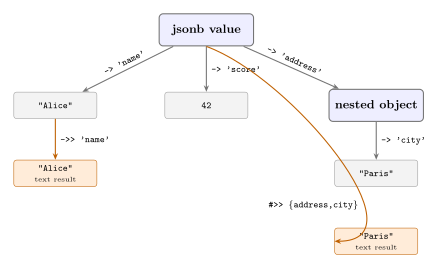
PostgreSQL has two JSON types: json (text with format validation) and
jsonb (binary, indexed, queryable). Use jsonb. The json type exists for
backwards compatibility.
jsonb supports three categories of operator. Path access operators
extract values: -> returns a jsonb value; ->> returns text.
Containment (@>) tests whether a document contains a given sub-document.
Existence (?) tests whether a key is present. None of these exist on
json.
-- Filter and project from a JSONB document store (magic.cards)
select data->>'name'     as card_name,
       data->>'type'     as card_type,
       data->>'manaCost' as mana_cost
  from magic.cards
 where data->>'type' like 'Creature%'
   and data->>'manaCost' is not null
 order by data->>'name'
 limit 5;
The magic.cards table stores each Magic: The Gathering card as a single
jsonb document. The column named data holds the entire card — name, type,
mana cost, subtypes, abilities — with no fixed schema enforced by the table.
->> extracts a field as text; -> returns the nested jsonb value, useful
when the field is itself an object or array.
GIN indexes make containment fast
A GIN (Generalized Inverted Index) indexes every key and value in a jsonb
column. With it, containment and existence queries hit the index rather than
scanning every document:
create index on magic.cards using gin (data);
explain (analyze, buffers)
  select data->>'name' as card_name,
         data->>'type' as card_type
    from magic.cards
   where data @> '{"type": "Creature — Human Wizard"}'::jsonb
   order by data->>'name';
The plan shows a Bitmap Index Scan on the GIN index, not a sequential scan.
Without the index, PostgreSQL must parse every document to evaluate @>.
PostgreSQL offers two GIN opclasses. The default (jsonb_ops) indexes all
keys and values and supports @>, ?, ?|, and ?&. The alternative
(jsonb_path_ops) indexes only values — it produces a smaller index and
faster @> lookups, but does not support the existence operators.
JSONPath: navigating nested documents
SQL/JSON path expressions (PostgreSQL 12+) navigate inside documents using
$ as the document root:
-- @?: does the card have "Dragon" in its subtypes array?
select count(*)
  from magic.cards
 where data @? '$.subtypes[*] ? (@ == "Dragon")';

-- @@: cards whose converted mana cost exceeds 8
select distinct data ->> 'name' as name,
       (data ->> 'cmc')::int    as cmc
  from magic.cards
 where data @@ '$.cmc > 8'
 order by cmc desc, name
 limit 6;

-- jsonb_path_query: extract each matching subtype element
select distinct data ->> 'name'                          as card,
       jsonb_path_query(data, '$.subtypes[*]')::text     as subtype
  from magic.cards
 where data @? '$.subtypes[*] ? (@ == "Dragon")'
 order by card
 limit 8;
@? tests whether any element matches the path (returns boolean). @@ tests
whether the path expression evaluates to true over the document. $.array[*]
iterates all elements; ?(@ == "Dragon") filters to elements equal to
"Dragon". The GIN index accelerates @? and @@ queries.
Decomposing documents with jsonb_each
jsonb_each() expands a jsonb object into (key, value) rows — the
relational inverse of jsonb_build_object(). Combined with LATERAL, it
decomposes documents for inspection:
select key, jsonb_typeof(value) as vtype
  from (select data from magic.cards
         where data @> '{"name":"Air Elemental"}' limit 1) c,
       lateral jsonb_each(c.data)
 order by key;
jsonb_typeof() returns the JSON type of a value: "string", "number",
"boolean", "array", "object", or "null". This is useful for auditing
document structure when the schema is not fixed.
When to use JSONB
JSONB is the right choice when:
- The shape of the data varies per row (product attributes, event metadata, configuration objects)
- You need to query inside the document — not just store and retrieve it whole
- The structure is not yet settled and you want schema flexibility while the data model evolves
JSONB is not the right choice when every row has the same structure and you know what columns you need. Typed columns are faster to query, easier to index selectively, and produce clearer error messages when data is wrong.
A useful pattern: start with JSONB when the schema is uncertain, then promote
frequently-queried keys to typed columns with ALTER TABLE ... ADD COLUMN and
an expression index or generated column as an intermediate step.
Arrays: a set of values in one column
Any PostgreSQL type can be stored as an array: text[], integer[],
timestamptz[]. The canonical use case is tags or labels — a small,
variable-length set of values that belongs to a single entity.
GIN indexing makes array containment queries fast:
create index on hashtag using gin (hashtags);
-- Find all tweets tagged with both #Hiring and #Retail:
select count(*)
  from hashtag
 where hashtags @> array['#Hiring', '#Retail'];
 count
═══════
   127
(1 row)
To process array contents as rows, use unnest():
  select tag, count(*)
    from hashtag, unnest(hashtags) as t(tag)
group by tag
order by count desc
   limit 10;
     tag     │ count
═════════════╪═══════
 #jobs       │  2341
 #Hiring     │  1892
 #USA        │  1654
 #NYC        │  1203
 #Retail     │   918
 #Marketing  │   876
 #Tech       │   743
 #startup    │   621
 #remote     │   589
 #HR         │   512
(10 rows)
Arrays are good for “store a few values together, query them as a set.” If you find yourself doing a lot of per-element lookups, joins, or updates, you probably need a proper lookup table instead.
The underlying principle
Both types — JSONB and arrays — store multiple values or a structured value in a single column, with operators and index types designed to query inside the value rather than treating it as opaque. That is what PostgreSQL’s extensibility model was designed to enable.
Use them when the data genuinely has a non-tabular shape. Avoid using them as a way to skip schema design — the update anomaly applies just as much when the repeated fact is buried inside a JSON document or packed into an array.
For intervals and time spans, PostgreSQL’s range types (tstzrange,
daterange, int4range) are the right model — covered in the
Range Types and Temporal Constraints
lesson.