LATERAL JOIN for Top-N Per Group
LATERAL lets the right-hand subquery reference columns from the left side — enabling top-N per group in a single scan without window functions and outer filters.
Top-N per group is one of the most commonly asked SQL questions. Given a list of drivers, what were each driver’s best three finishes of the 2017 season?
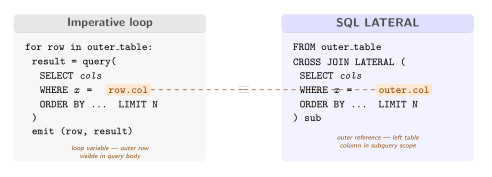
The right-hand side of a LATERAL join is a subquery that can reference
columns from the left side. PostgreSQL evaluates it once per left-hand row —
like a correlated subquery, but returning multiple rows. Adding GROUPING SETS
to the outer query produces a subtotal row per driver alongside the detail rows:
select d.surname          as driver,
       top3.race,
       top3.pos,
       sum(top3.points)   as points
  from f1db.drivers d
  join lateral (
      select r.name            as race,
             res.positionorder as pos,
             res.points
        from f1db.results res
        join f1db.races   r on r.raceid = res.raceid
       where res.driverid = d.driverid
         and r.year       = 2017
         and res.points   > 0
       order by res.points desc
       limit 3
  ) top3 on true
 where d.surname in ('Hamilton', 'Vettel', 'Bottas', 'Ricciardo', 'Verstappen')
 group by grouping sets (
   (d.surname, top3.race, top3.pos),   -- one row per race
   (d.surname)                          -- one subtotal row per driver
 )
 order by d.surname,
          grouping(top3.race, top3.pos),
          sum(top3.points) desc nulls last;
   driver   │         race          │ pos │ points
════════════╪═══════════════════════╪═════╪════════
 Bottas     │ Austrian Grand Prix   │   1 │     25
 Bottas     │ Russian Grand Prix    │   1 │     25
 Bottas     │ Canadian Grand Prix   │   2 │     18
 Bottas     │ ¤                     │   ¤ │     68
 Hamilton   │ Canadian Grand Prix   │   1 │     25
 Hamilton   │ Chinese Grand Prix    │   1 │     25
 Hamilton   │ Spanish Grand Prix    │   1 │     25
 Hamilton   │ ¤                     │   ¤ │     75
 Ricciardo  │ Azerbaijan Grand Prix │   1 │     25
 Ricciardo  │ Spanish Grand Prix    │   3 │     15
 Ricciardo  │ Monaco Grand Prix     │   3 │     15
 Ricciardo  │ ¤                     │   ¤ │     55
 Verstappen │ Chinese Grand Prix    │   3 │     15
 Verstappen │ British Grand Prix    │   4 │     12
 Verstappen │ Australian Grand Prix │   5 │     10
 Verstappen │ ¤                     │   ¤ │     37
 Vettel     │ Australian Grand Prix │   1 │     25
 Vettel     │ Bahrain Grand Prix    │   1 │     25
 Vettel     │ Monaco Grand Prix     │   1 │     25
 Vettel     │ ¤                     │   ¤ │     75
(20 rows)
The subquery references d.driverid — a column from the left side — which is
what makes it LATERAL. Without LATERAL, that reference would be a syntax
error. The LIMIT 3 runs inside the subquery, so only three rows are
returned per driver, not three rows surviving an outer filter over all rows.
GROUPING SETS in the outer query adds a second grouping: for (d.surname)
alone, race and pos collapse to NULL and SUM(points) totals the three
races. The grouping(top3.race, top3.pos) expression in ORDER BY returns a
non-zero value for those subtotal rows, sorting them after the detail rows
within each driver. The result is 15 detail rows plus 5 subtotal rows — 20 in
total.
JOIN LATERAL (...) ON TRUE is the standard idiom when the join condition is
always true — the correlation happens inside the subquery, not in the ON
clause. Use LEFT JOIN LATERAL (...) ON TRUE to keep left-hand rows even when
the subquery returns zero rows (the equivalent of LEFT JOIN).
The window function alternative
The same top-3 result is achievable with ROW_NUMBER():
select driver, race, pos, points
  from (
    select d.surname          as driver,
           r.name             as race,
           res.positionorder  as pos,
           res.points,
           row_number() over (
             partition by d.driverid
             order by res.points desc
           ) as rn
      from f1db.results res
      join f1db.races   r on r.raceid = res.raceid
      join f1db.drivers d on d.driverid = res.driverid
     where r.year = 2017
       and res.points > 0
       and d.surname in ('Hamilton', 'Vettel', 'Bottas', 'Ricciardo', 'Verstappen')
  ) ranked
 where rn <= 3
 order by driver, points desc;
   driver   │         race          │ pos │ points
════════════╪═══════════════════════╪═════╪════════
 Bottas     │ Russian Grand Prix    │   1 │     25
 Bottas     │ Austrian Grand Prix   │   1 │     25
 Bottas     │ Canadian Grand Prix   │   2 │     18
 Hamilton   │ Chinese Grand Prix    │   1 │     25
 Hamilton   │ Canadian Grand Prix   │   1 │     25
 Hamilton   │ Spanish Grand Prix    │   1 │     25
 Ricciardo  │ Azerbaijan Grand Prix │   1 │     25
 Ricciardo  │ Monaco Grand Prix     │   3 │     15
 Ricciardo  │ Canadian Grand Prix   │   3 │     15
 Verstappen │ Chinese Grand Prix    │   3 │     15
 Verstappen │ British Grand Prix    │   4 │     12
 Verstappen │ Hungarian Grand Prix  │   5 │     10
 Vettel     │ Bahrain Grand Prix    │   1 │     25
 Vettel     │ Hungarian Grand Prix  │   1 │     25
 Vettel     │ Monaco Grand Prix     │   1 │     25
(15 rows)
The structure differs: the window function approach computes rn for every row
in the filtered set, then discards all but the top 3 in an outer WHERE. When
there are ties for third place, ROW_NUMBER() breaks them arbitrarily — so the
two queries can pick different races for Ricciardo and Verstappen where points
are equal. RANK() instead of ROW_NUMBER() would keep all tied rows but
could return more than 3.
LATERAL is preferable when:
- The
LIMITor filter is complex and benefits from running close to the data - You want to push the cutoff inside the subquery and avoid generating intermediate rows
- The subquery is essentially independent logic that happens to need one value from the outer query
Window functions are preferable when you need the ranking and the detail rows, or when you want to apply multiple windowed computations in one pass.
Under the hood
EXPLAIN makes the structural difference concrete. Both plans are abridged to
the nodes that matter:
LATERAL + GROUPING SETS:
Nested Loop
  -> Seq Scan on drivers d                            rows=7
       Filter: surname = ANY ('{Hamilton,...}')
  -> Limit                                            ← stops after 3 rows per driver
       -> Sort  (Sort Key: res.points DESC)
            -> Nested Loop (results × races)
                 -> Seq Scan on results res           ← re-runs for each driver
                      Filter: (points > 0
                               AND driverid = d.driverid)
                 -> Seq Scan on races r
                      Filter: (year = 2017)
Window function:
WindowAgg
  Run Condition: (row_number() OVER (?) <= 3)         ← PG 14+ early-exit per partition
  -> Sort  (Sort Key: d.driverid, res.points DESC)    ← sort ALL qualifying rows first
       -> Hash Join  (Hash Cond: res.driverid = d.driverid)
            -> Seq Scan on results res   rows=6590     ← one scan of all scoring results
                 Filter: (points > 0)
            -> Hash
                 -> Seq Scan on drivers d   rows=7
                      Filter: surname = ANY (...)
Two differences stand out:
Scan count. LATERAL re-scans results once per driver (7 × cost 765); the
window function scans it once (cost 706, returning 6,590 rows). Without indexes,
the window function wins on I/O. Add an index on results(driverid, points desc)
and LATERAL flips: each inner scan becomes a cheap index seek that stops at row 3,
while the window function still has to sort every qualifying row in each partition
before the Run Condition can trigger.
Where the cutoff lands. LATERAL’s Limit sits inside the Nested Loop — rows
stop being generated after 3, before they reach the GroupAggregate. The window
function’s Run Condition (PostgreSQL 14+) is an early-exit hint per partition, but
it fires after the preceding Sort has already ordered every qualifying row across
all five drivers. The cutoff is later in the pipeline.