What is an SQL JOIN?
Forget the set-theory Venn diagrams. A JOIN composes two collections of objects into a new collection that has the properties of both.
It took me quite some time before I could reason efficiently about SQL JOINs — and the set-theory Venn diagrams never really helped me understand them. So today I want to help you understand JOINs in a different way, hoping to make the concept click at once.
As we saw in What is an SQL relation?, a relation is a collection of objects, all sharing the same definition. SQL introduces relations and operators to compose them.
In mathematics you can define a new function H as applying F, then G, to
some object: H = F ∘ G, meaning H(x) = F(G(x)). Functional languages all
have a way to express this composition, building a new function from simpler
ones.
In SQL we compose relations: we build a new relation from two existing ones. Both inputs have objects with certain attributes. You typically want a new collection of objects that has properties from both collections.
That’s it. That’s a SQL JOIN.
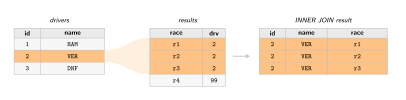
Here’s an example, taken from the book:
-- name: list-albums-by-artist
-- List the album titles and duration of a given artist
  select album.title as album,
         sum(milliseconds) * interval '1 ms' as duration
    from album
         join artist using(artist_id)
         left join track using(album_id)
   where artist.name = 'Red Hot Chili Peppers'
group by album
order by album;
In this query we build a new relation composing objects from ALBUM with
objects from ARTIST: the result has the properties of both, enriching each
album with the artist sharing the same artist_id. That JOIN is all it means:
for each album, add the information from the matching artist.
Next, the LEFT JOIN composes that with the TRACK collection, producing
objects that carry the properties of ALBUM, ARTIST, and TRACK.
┌───────────────────────┬──────────────────────────────┐
│         album         │           duration           │
├───────────────────────┼──────────────────────────────┤
│ Blood Sugar Sex Magik │ @ 1 hour 13 mins 57.073 secs │
│ By The Way            │ @ 1 hour 8 mins 49.951 secs  │
│ Californication       │ @ 56 mins 25.461 secs        │
└───────────────────────┴──────────────────────────────┘
(3 rows)
A JOIN composes two relations into a new one. Once you see joins as composition
rather than overlapping circles, the whole family — INNER, LEFT/RIGHT
OUTER, CROSS, and even LATERAL — falls into place.