WITH RECURSIVE: Walking a River Network
Follow a parent reference up a tree of unknown depth — a whole river basin — with a query that refers back to its own output.
Some questions can’t be answered by a single pass over a table — they need a
query that refers back to its own output and keeps going until there’s nothing
left to add. SQL spells that with recursive, and a river network is the
perfect place to see why.
We use the HydroRIVERS dataset (loaded with taop hydrorivers), clipped to
France. Every reach of every river is one row, and the key column is
next_down: the id of the reach this one flows into (or 0 at the sea). That
single column turns the table into a tree.
\d hydrorivers.rivers
   Column   |   Type   | description
------------+----------+--------------------------------------------
 hyriv_id   | bigint   | this reach
 next_down  | bigint   | the reach it flows into (0 = reaches the sea)
 main_riv   | bigint   | the basin's outlet reach (its "name")
 ord_stra   | integer  | Strahler stream order
 geom       | geometry | the reach, a line
The problem
We want every reach that drains into the Loire — the whole basin, from the
mouth at Saint-Nazaire up to the smallest headwater. The Loire’s outlet reach is
hyriv_id = 20446779. How do we follow next_down backwards, all the way up?
Start with what you can see
The main_riv column labels every reach with its basin’s outlet id, and
ord_stra is the Strahler stream order — higher means larger. A flat query
gets the main channels without any recursion:
select hyriv_id, geom, ord_stra
  from hydrorivers.rivers
 where main_riv = 20446779   -- the Loire basin
   and ord_stra >= 6;        -- trunk and major tributaries only
That gives 155 reaches — the Loire trunk and its biggest branches:
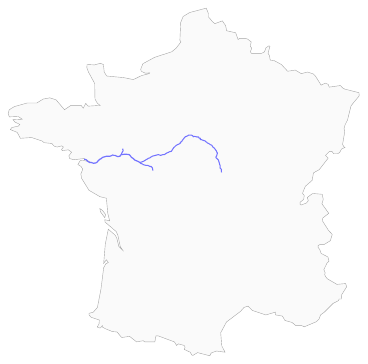
We had to guess the threshold, and the smaller streams that feed those channels
are still invisible. The connectivity lives in next_down.
Building up manually, ring by ring
Use the mainstem as a seed and add one ring of confluents at a time. Ring 1
— every reach whose next_down lands on a mainstem channel:
with mainstem as (
  select hyriv_id, geom, ord_stra
    from hydrorivers.rivers
   where main_riv = 20446779 and ord_stra >= 6
)
  select geom, ord_stra from mainstem           -- 155 high-order channels

union all

  select r.geom, r.ord_stra
    from hydrorivers.rivers r
    join mainstem m on r.next_down = m.hyriv_id
   where r.main_riv = 20446779
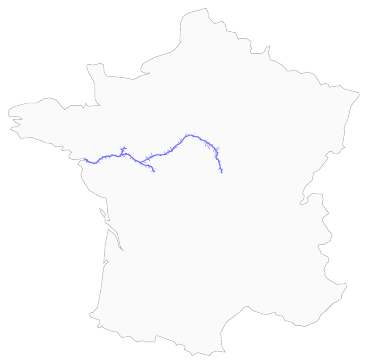
     and r.ord_stra < 6;                        -- 161 direct tributaries
316 reaches total — the first tributaries appear at every confluence:
Ring 2 — name the first ring and repeat: add every reach that flows into a ring-1 channel:
with mainstem as (
  select hyriv_id, geom, ord_stra
    from hydrorivers.rivers
   where main_riv = 20446779 and ord_stra >= 6
),
ring1 as (
  select r.hyriv_id, r.geom, r.ord_stra
    from hydrorivers.rivers r
    join mainstem m on r.next_down = m.hyriv_id
   where r.main_riv = 20446779 and r.ord_stra < 6
)
  select geom, ord_stra from mainstem
union all
  select geom, ord_stra from ring1              -- 161 direct tributaries
union all
  select r.geom, r.ord_stra
    from hydrorivers.rivers r
    join ring1 on r.next_down = ring1.hyriv_id
   where r.main_riv = 20446779;                -- 132 more: total 448
448 reaches — and the pattern is clear:
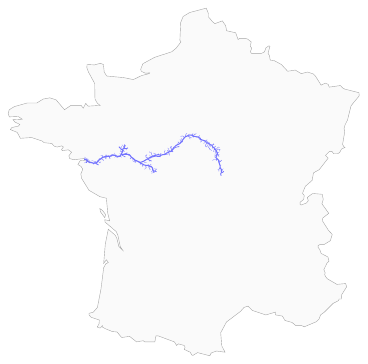
Every additional ring requires a new CTE and a new self-join. The Loire basin has 6,297 reaches. We are not writing 6,297 CTEs, and we don’t even know the depth ahead of time. This is exactly what recursion is for.
The query
A with recursive CTE does the self-join for us, over and over, until a round
adds nothing new:
with recursive loire as (

       select hyriv_id, geom, ord_stra            -- base case
         from hydrorivers.rivers
        where hyriv_id = 20446779                  --   the outlet

    union all

       select r.hyriv_id, r.geom, r.ord_stra       -- recursive term
         from hydrorivers.rivers as r
              join loire on r.next_down = loire.hyriv_id   -- one step upstream
)
select count(*) from loire;
 count
-------
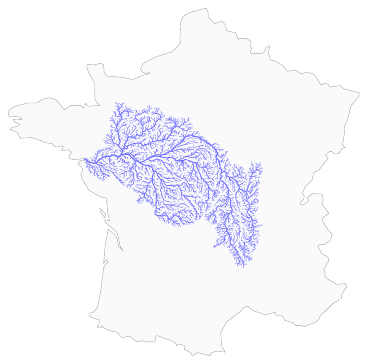
  6297
Every reach of the basin, gathered in one query — and we never named a single tributary. Plotted, it draws the whole Loire system:
How it works
A with recursive CTE always has the same two-part shape, joined by union all:
- The base case seeds the result — here, the single outlet reach.
- The recursive term refers back to the CTE by name (
loire) and produces more rows from the ones found so far. PostgreSQL runs it again and again, each round seeing only the rows the previous round added, and stops when a round adds nothing.
The join on r.next_down = loire.hyriv_id is what walks the tree: give me every
reach that flows into a reach I already have. Flip it to
on r.hyriv_id = loire.next_down and the same query traces a single reach the
other way — downstream to the sea.
The same pattern handles any hierarchy stored as a parent reference: an org chart, a threaded comment section, a bill of materials, a category tree — or a river and all its tributaries.