Why Postgres?
PostgreSQL is not just storage — it is a concurrent data-access service. Here is what that means, and why the PostgreSQL project specifically is the right choice for any serious application.
The following concepts are important to keep in mind when working with PostgreSQL:
Relational Database Management System
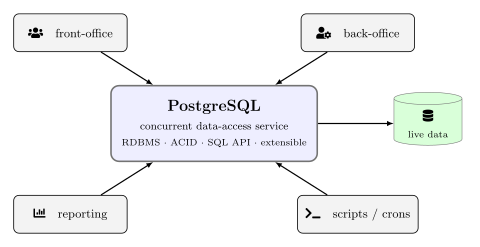
PostgreSQL is an RDBMS and as such its role in your software architecture is to handle concurrent access to live data that is manipulated by several applications, or several parts of an application.
Typically we will find the user-side parts of the application, a front-office and a user back-office with a different set of features depending on the user role, including some kinds of reporting (accounting, finance, analytics), and often some glue scripts here and there, crontabs or the like.
Atomic, Consistent, Isolated, Durable
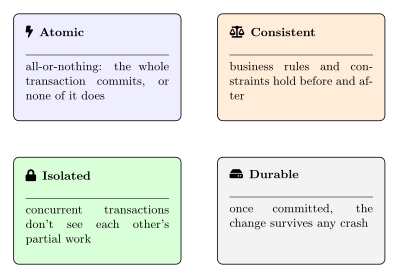
At the heart of the concurrent access semantics is the concept of a transaction. A transaction should be atomic and isolated, the latter allowing for online backups of the data.
Additionally, the RDBMS is tasked with maintaining a data set that is consistent with the business rules at all times. That’s why database modeling and normalization tasks are so important, and why PostgreSQL supports an advanced set of constraints.
Durable means that whatever happens PostgreSQL guarantees that it won’t lose any committed change. Your data is safe. Not even an OS crash is allowed to risk your data. We’re left with disk corruption risks, and that’s why being able to carry out online backups is so important.
Data Access API and Service
Given the characteristics listed above, PostgreSQL allows one to implement a data access API. In a world of containers and micro-services, PostgreSQL is the data access service, and its API is SQL.
If it looks a lot heavier than your typical micro-service, remember that PostgreSQL implements a stateful service, on top of which you can build the other parts. Those other parts will be scalable and highly available by design, because solving those problems for stateless services is so much easier.
Structured Query Language
The data access API offered by PostgreSQL is based on the SQL programming language. It’s a declarative language where your job as a developer is to describe in detail the result set you are interested in.
PostgreSQL’s job is then to find the most efficient way to access only the data needed to compute this result set, and execute the plan it comes up with.
Extensible (JSON, XML, Arrays, Ranges)
The SQL language is statically typed: every query defines a new relation that must be fully understood by the system before executing it. That’s why sometimes cast expressions are needed in your queries.
PostgreSQL’s unique approach to implementing SQL was invented in the 80s with the stated goal of enabling extensibility. SQL operators and functions are defined in a catalog and looked up at run-time. Functions and operators in PostgreSQL support polymorphism and almost every part of the system can be extended.
This unique approach has allowed PostgreSQL to be capable of improving SQL; it offers a deep coverage for composite data types and documents processing right within the language, with clean semantics.
So when designing your software architecture, think about PostgreSQL not as storage layer, but rather as a concurrent data access service. This service is capable of handling data processing. How much of the processing you want to implement in the SQL part of your architecture depends on many factors, including team size, skill set, and operational constraints.
Why PostgreSQL?
While this course focuses on teaching SQL and how to make the best of this programming language in modern application development, it only addresses the PostgreSQL implementation of the SQL standard. That choice is down to several factors, all consequences of PostgreSQL truly being the world’s most advanced open source database:
PostgreSQL is open source, available under a BSD-like licence named the PostgreSQL licence.
The PostgreSQL project is done completely in the open, using public mailing lists for all discussions, contributions, and decisions, and the project goes as far as self-hosting all requirements in order to avoid being influenced by a particular company.
While being developed and maintained in the open by volunteers, most PostgreSQL developers today are contributing in a professional capacity, both in the interest of their employer and to solve real customer problems.
PostgreSQL releases a new major version about once a year, following a when it’s ready release cycle.
The PostgreSQL design, ever since its Berkeley days under the supervision of Michael Stonebraker, allows enhancing SQL in very advanced ways, as we see in the data types and indexing support parts of this book.
The PostgreSQL documentation is one of the best reference manuals you can find, open source or not, and that’s because a patch in the code is only accepted when it also includes editing the parts of the documentations that need editing.
While new NoSQL systems are offering different trade-offs in terms of operations, guarantees, query languages and APIs, I would argue that PostgreSQL is YeSQL!
In particular, the extensibility of PostgreSQL allows this 20-year-old system to keep renewing itself. As a data point, this extensibility design makes PostgreSQL one of the best JSON processing platforms you can find.
It makes it possible to improve SQL with advanced support for new data types even from “userland code”, and to integrate processing functions and operators and their indexing support.
We’ll see lots of examples of that kind of integration in this course. One of them is a query used in the schemaless design section where we deal with a Magic™ The Gathering set of cards imported from a JSON data set:
select jsonb_pretty(data)
  from magic.cards
 where data @> '{
                 "type":"Enchantment",
                 "artist":"Jim Murray",
                 "colors":["White"]
                }';
The @> operator reads contains and implements JSON searches, with
support from a specialized GIN index if one has been created. The
jsonb_pretty() function does what we can expect from its name, and the
query returns magic.cards rows that match the JSON criteria for given
type, artist and colors key, all as a pretty printed JSON document.
PostgreSQL extensibility design is what allows one to enhance SQL in that way. The query still fully respects SQL rules, there are no tricks here. It is only functions and operators, positioned where we expect them in the where clause for the searching and in the select clause for the projection that builds the output format.