The OVER Clause: One Result Per Row Without GROUP BY
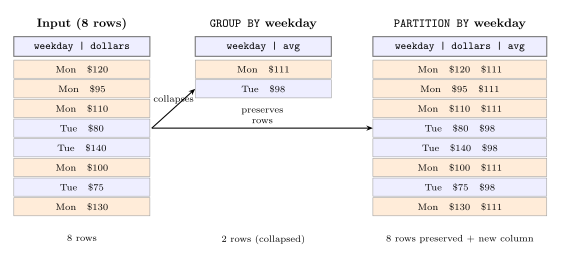
OVER turns any aggregate into a window function — computing a result across a set of rows while still returning every row intact.
Window functions let you compute an aggregate and keep the detail rows at
the same time. No subquery, no self-join — just OVER.
You already know the aggregate half: SUM, COUNT, AVG — the same
functions you use with GROUP BY. OVER is what happens when you take
those same functions and ask for the result on every row instead of one
result per group. The rows stay; the aggregate travels with them.
A concrete example
The F1 database records race results. To get the top five from race 890 and see each driver’s total race time, you write a plain query:
  select surname, position,
         milliseconds * interval '1ms' as racetime
    from results
         join drivers using(driverid)
   where raceid = 890
order by position limit 5;
  surname  │ position │           racetime
═══════════╪══════════╪══════════════════════════════
 Hamilton  │        1 │ @ 1 hour 42 mins 29.445 secs
 Räikkönen │        2 │ @ 1 hour 42 mins 40.383 secs
 Vettel    │        3 │ @ 1 hour 42 mins 41.904 secs
 Webber    │        4 │ @ 1 hour 42 mins 47.489 secs
 Alonso    │        5 │ @ 1 hour 43 mins 0.856 secs
(5 rows)
Now suppose you want to also show the gap between each driver and the one ahead of them. A window function adds that as a single expression — no self-join, no subquery:
  select surname, position,
         milliseconds * interval '1ms' as racetime,
         interval '1ms' *
         (
           milliseconds - lag(milliseconds, 1) over(order by position)
         ) as diff
    from results
         join drivers using(driverid)
   where raceid = 890
order by position limit 5;
  surname  │ position │           racetime           │     diff
═══════════╪══════════╪══════════════════════════════╪═══════════════
 Hamilton  │        1 │ @ 1 hour 42 mins 29.445 secs │ ¤
 Räikkönen │        2 │ @ 1 hour 42 mins 40.383 secs │ @ 10.938 secs
 Vettel    │        3 │ @ 1 hour 42 mins 41.904 secs │ @ 1.521 secs
 Webber    │        4 │ @ 1 hour 42 mins 47.489 secs │ @ 5.585 secs
 Alonso    │        5 │ @ 1 hour 43 mins 0.856 secs  │ @ 13.367 secs
(5 rows)
lag(milliseconds, 1) looks back one row — in the order defined by
over(order by position) — and returns that row’s value. The winner has no
predecessor, so their diff is NULL. Every other driver shows the gap to the
car ahead.
What OVER () means
OVER () with no arguments is the simplest window: the entire result set.
Every row sees every other row when computing the function. You can add
PARTITION BY to divide the result into independent sub-windows, and
ORDER BY to define row sequence within each partition. Both are optional.
The function before OVER can be any aggregate (sum, avg, count) or a
window-specific function (lag, lead, rank, row_number,
dense_rank). It computes across the window and returns one value per row.
When to reach for it
Reach for a window function whenever you need a derived value that depends on other rows without losing the current row. Running totals, rankings, comparisons to a previous or next period, moving averages, and percentile positions are all natural fits.
When you find yourself reaching for a self-join or a correlated subquery
to compute “the value from the row before this one,” a window function is
the cleaner path. lag() was built exactly for that.
The championship battle, round by round
SUM with GROUP BY can tell you who won the 2016 championship and by
how many points. What it cannot tell you is how the gap opened — which
races shifted the balance, and when the title was effectively decided.
A running total with OVER keeps every row and adds the cumulative
picture:
select r.round,
       r.name     as race,
       d.surname,
       res.points as race_points,
       sum(res.points) over (
         partition by d.driverid
         order by r.round
       ) as total_after_round
  from f1db.results res
  join f1db.races   r using (raceid)
  join f1db.drivers d using (driverid)
 where r.year = 2016
   and d.surname in ('Rosberg', 'Hamilton', 'Ricciardo', 'Verstappen')
 order by r.round, total_after_round desc;
 round │         race          │  surname   │ race_points │ total_after_round
═══════╪═══════════════════════╪════════════╪═════════════╪═══════════════════
     1 │ Australian Grand Prix │ Rosberg    │          25 │                25
     1 │ Australian Grand Prix │ Hamilton   │          18 │                18
     1 │ Australian Grand Prix │ Ricciardo  │          12 │                12
     1 │ Australian Grand Prix │ Verstappen │           1 │                 1
     2 │ Bahrain Grand Prix    │ Rosberg    │          25 │                50
     2 │ Bahrain Grand Prix    │ Hamilton   │          15 │                33
     2 │ Bahrain Grand Prix    │ Ricciardo  │          12 │                24
     2 │ Bahrain Grand Prix    │ Verstappen │           8 │                 9
     3 │ Chinese Grand Prix    │ Rosberg    │          25 │                75
     3 │ Chinese Grand Prix    │ Hamilton   │           6 │                39
     3 │ Chinese Grand Prix    │ Ricciardo  │          12 │                36
     3 │ Chinese Grand Prix    │ Verstappen │           4 │                13
     4 │ Russian Grand Prix    │ Rosberg    │          25 │               100
     4 │ Russian Grand Prix    │ Hamilton   │          18 │                57
     4 │ Russian Grand Prix    │ Ricciardo  │           0 │                36
     4 │ Russian Grand Prix    │ Verstappen │           0 │                13
     5 │ Spanish Grand Prix    │ Rosberg    │           0 │               100
     5 │ Spanish Grand Prix    │ Hamilton   │           0 │                57
     5 │ Spanish Grand Prix    │ Ricciardo  │          12 │                48
     5 │ Spanish Grand Prix    │ Verstappen │          25 │                38
     6 │ Monaco Grand Prix     │ Rosberg    │           6 │               106
     6 │ Monaco Grand Prix     │ Hamilton   │          25 │                82
     6 │ Monaco Grand Prix     │ Ricciardo  │          18 │                66
     6 │ Monaco Grand Prix     │ Verstappen │           0 │                38
(84 rows)
Each row is still a race result — one driver, one round, the points
scored that day. The total_after_round column carries the cumulative
season total, growing with each round. Round 5 is the Spanish Grand Prix,
where both Rosberg and Hamilton collided and retired — race_points = 0
for both, while Verstappen took his first ever win and leapt from 13 to 38
points. The total_after_round column captures that shift immediately;
GROUP BY would silently absorb it into a season total.
The SUM is the same aggregate you already know. Two new things appear
inside OVER: PARTITION BY driverid restarts the running total
independently for each driver, and ORDER BY round defines which rows
have accumulated so far. Both are covered in depth in the course.
GROUP BY year, driverid would collapse the 84 rows to four and hand you
the final totals — Rosberg 385, Hamilton 380. The window version gives you
the whole story of a five-point championship decided on the last lap of
the last race.